


Tell us about your goals and we’ll create a custom PBN backlink strategy that drives real rankings and long-term growth.

Mon-Fri: 09:00 AM – 06:00 PM
Search visibility for a forex brokerage is not built through keyword volume alone. It depends on whether the website can demonstrate relevance, technical quality, market-specific expertise, regulatory accuracy, and sufficient authority and trust to compete in a tightly scrutinised financial category.
The strongest SEO strategies for forex businesses connect commercial priorities with search intent. That means creating high-quality content for clearly defined audiences, improving website optimization, building credible references, and measuring whether organic traffic contributes to qualified registrations, partner enquiries, or other business outcomes. Results depend on market, regulation, competition, website quality, and execution.
Forex SEO Challenges Brokers Face
A strategy for forex search visibility must account for conditions that do not affect many ordinary B2B websites. Financial topics receive greater scrutiny, acquisition rules differ by jurisdiction, and established publishers often control high-value search engine rankings.
YMYL Classification
Forex trading content falls within a financially sensitive environment because inaccurate information may influence decisions involving money and risk. Even when a page is intended for business development rather than retail education, the wider website may contain claims about products, execution, leverage, spreads, regulation, or market access.
Google recommends creating helpful, reliable, people-first content and places particular emphasis on trust for topics that may affect financial stability. A successful forex SEO program, therefore, needs stronger editorial controls than a typical software or lifestyle website.
Useful trust signals include:
- Clearly identified operating entities and jurisdictions
- Verifiable licence and registration details
- Named authors, reviewers, and subject-matter specialists
- Accurate publication and revision dates
- Transparent risk disclosures
- Accessible complaints, privacy, and conflict-of-interest policies
- Sources supporting factual or regulatory claims
These elements do not guarantee improved rankings. They reduce ambiguity about who operates the website, who is responsible for its information, and whether the material has been reviewed appropriately.
Regulatory Content Constraints
SEO and compliance should be planned together rather than treated as separate approval stages. A technically well-optimized page can still create regulatory exposure when its title, snippet, body copy, video, or call to action presents an unbalanced view of a financial product.
Regulatory requirements vary across multiple markets. For example, the UK Financial Conduct Authority states that financial promotions should be fair, clear, not misleading, and capable of supporting consumer understanding. Its social media financial promotions guidance also emphasizes balanced communication of benefits and risks.
A practical review workflow should examine:
- The intended audience and jurisdiction
- Whether the page is informational or promotional
- Product claims and substantiation
- Required risk warnings and qualifying language
- The relationship between headline, body copy, and call to action
- Translation accuracy in every target market
- Whether screenshots, charts, testimonials, or examples create an implied claim
Part of any forex content process should be a documented approval route involving marketing, legal, compliance, and product specialists where appropriate. Publishing first and correcting later can create inconsistent messaging, indexing problems, and unnecessary reputational risk.
Competitive Forex Search Landscape
The forex industry competes against brokers, financial publishers, educational portals, software providers, affiliates, regulators, news organizations, and community websites. A new domain may therefore struggle to gain visibility for broad terms even when its pages are technically sound.
Competitor analysis should distinguish between direct commercial rivals and search competitors. A financial newspaper may not compete for accounts, but it can control informational results. An affiliate publisher may rank for comparison terms without offering brokerage services. A regulator may dominate queries involving licence verification.
Assess competitors across four dimensions:
| Area | Questions to investigate | Strategic implication |
| Search coverage | Which topics and query types produce visibility? | Reveals realistic gaps rather than only high-volume terms |
| Content quality | Is the material original, well-researched, reviewed, and current? | Establishes the standard required to compete |
| Authority | Which reputable websites cite or reference the domain? | Identifies digital PR and link-building opportunities |
| User experience | Are pages fast, clear, mobile-friendly, and easy to navigate? | Shows where usability may support stronger engagement |
Forex Keyword Research and Search Intent
Keyword selection should begin with the business model and audience, not a downloaded list of popular phrases. The right keywords connect a defined search need with a page that your organization is qualified and permitted to publish.
Keyword Research Tools and Techniques
Keyword platforms can estimate demand, competition, related terms, and ranking pages. Search Console data, customer-support records, sales calls, internal site search, and tools like Google Analytics can provide additional evidence about how audiences discover and use the website.
A practical research process is:
- Map products, markets, technologies, and audience segments.
- Collect seed terms from product, compliance, sales, and support teams.
- Expand them through keyword tools and search result analysis.
- Classify each term by intent, jurisdiction, and funnel stage.
- Review the pages currently ranking.
- Remove queries that the business cannot answer credibly or compliantly.
- Assign one clear primary purpose to each proposed page.
Do not use forex terminology merely because it has high search volume. A phrase must reflect the page’s real subject. Otherwise, weak relevance can lead to low click-through rates, poor user engagement, and elevated bounce rates.
Commercial and Transactional Forex Keywords
Commercial searches may involve account types, platform capabilities, liquidity models, integrations, pricing structures, regional availability, or institutional services. These searches can be valuable, but they are also highly competitive and often close to regulated conversion journeys.
Pages targeting commercial intent should provide decision-ready information rather than vague promotional copy. Depending on the business model, useful details may include:
- Supported platforms and integration methods
- Account eligibility and jurisdictional restrictions
- Execution model explanations
- Fee or spread methodology
- Funding and withdrawal processes
- Institutional or introducing-broker capabilities
- Technical documentation
- Customer support availability
- Entity and regulatory information
Commercial pages should not make unsupported superiority claims. “Best,” “safest,” and similar language can create both credibility and compliance concerns unless the claim is narrowly defined, independently substantiated, current, and legally approved.
Informational Search Queries
Informational queries allow a forex brokerage or technology provider to demonstrate expertise before a user reaches a commercial page. Topics may cover platform functionality, market structure, execution terminology, account administration, regulation, security controls, or operational processes.
The objective is not to insert a sales pitch into every explanation. Quality content should resolve the query, clarify limitations, and direct readers to a related resource only when the next step is relevant.
Strong informational pages often include:
- A concise answer near the beginning
- Definitions written for the intended knowledge level
- Examples with clear assumptions
- Tables explaining distinctions
- Named sources for regulatory or statistical claims
- Review dates where information can change
- Contextual internal links
- A restrained and relevant call to action
This approach can attract potential clients organically while building a body of evidence that demonstrates subject knowledge.
Long-Tail Keywords for Niche Targeting
Long-tail phrases usually express more specific needs than broad terms. They may relate to a particular platform, account structure, regulatory jurisdiction, integration requirement, language, or business model.
For example, a broker technology provider may have greater relevance for a query about multi-asset back-office integration than for a broad phrase such as forex trading platform. A regulated operator may be able to publish a stronger country-specific account eligibility page than a generic global overview.
Long-tail planning should consider:
- Audience type, such as retail, professional, institutional, or partner
- Product or technical requirement
- Geographic qualifier
- Regulatory context
- Problem, question, or comparison
- Expected next step
These queries may have lower reported volume, but they can help specific pages reach better-qualified visitors. Their value should be measured through engagement and commercial contribution, not traffic totals alone.
Topical Authority and SEO Content Strategy

Topical authority develops when a website covers a relevant subject with depth, consistency, clear ownership, and meaningful connections between pages. It cannot be created by publishing hundreds of lightly edited articles around near-duplicate keywords.
SEO Silos Around Trader Journeys
Content architecture should reflect user journeys while remaining aligned with the company’s role. A brokerage may need sections for platform use, accounts, execution, costs, regulation, funding, and support. A B2B provider may organize material around brokerage launch, liquidity, CRM, compliance technology, integrations, and operations.
A useful silo might connect:
- A broad platform overview
- Feature-specific explanations
- Set up and technical documentation
- Security and reliability information
- Regional availability
- Frequently asked operational questions
- Relevant commercial pages
Each silo should have a clear hub page and supporting resources. This improves navigation, helps search systems understand relationships, and reduces the risk of several pages competing for the same query.
Long-Form Intent-Driven Content
Long-form content is useful when the search intent genuinely requires detailed treatment. Word count alone is not a quality signal. A 3,000-word article that avoids the central question is less useful than a focused 1,200-word guide written by someone with relevant experience.
Before creating a substantial resource, define:
- The primary question
- The intended reader
- The decisions the page should support
- The necessary evidence
- Topics that belong on separate supporting pages
- The appropriate reviewer
- The revision schedule
Creating high-quality content may require interviews with dealing, product, legal, compliance, technology, or client-service teams. That input can produce practical detail that generic writing cannot replicate.
Educational Content for Forex Audiences
Educational material can support visibility, but it must fit the organization’s positioning. A B2B website should not drift into signals, profit promises, or prescriptive trading strategies simply because such topics receive search demand.
Appropriate subjects may include:
- How trading infrastructure components interact
- What does execution terminology mean
- How platform order types function operationally
- Why pricing can differ across venues
- How margin and leverage mechanics are presented
- What risk controls a platform may offer
- How regulatory permissions differ by entity
When material discusses forex traders or retail behavior, it should remain factual and balanced. Examples should explain mechanics rather than imply likely returns or recommend a course of action.
Internal Linking Between Topic Clusters
Internal links should help readers move between related questions and show the relationship between broad and detailed resources. They should not be inserted solely to force exact-match anchors onto every page.
A sensible linking pattern connects:
- Supporting guides to their central hub
- Informational pages to relevant product documentation
- Regional pages to applicable regulatory information
- Older analysis to updated methodology pages
- Technical articles on integration or security resources
Anchor text should describe the destination naturally. Repeated phrases across hundreds of pages can look mechanical and provide a poor reading experience. Periodic crawls can identify orphan pages, broken links, excessive link depth, and sections receiving little internal authority.
Content Planning Based on Funnel Stages
Content marketing should cover more than acquisition-stage queries. Decision-makers, partners, and prospective users may need different information while researching, evaluating, onboarding, and using a service.
A practical funnel framework includes:
| Stage | Typical need | Suitable content |
| Discovery | Understand a concept or operational issue | Definitions, explainers, research, and market structure guides |
| Evaluation | Compare approaches or capabilities | Feature matrices, methodology pages, integration guides |
| Validation | Confirm legitimacy and suitability | Entity details, security controls, policies, expert profiles |
| Onboarding | Complete the setup correctly | Documentation, checklists, and account process guides |
| Retention | Use the service effectively | Product updates, support resources, and technical education |
The digital marketing strategy should define how each stage contributes to qualified demand, customer understanding, or operational efficiency. Not every article needs to generate an immediate conversion.
Content Types That Rank for Forex Brokers
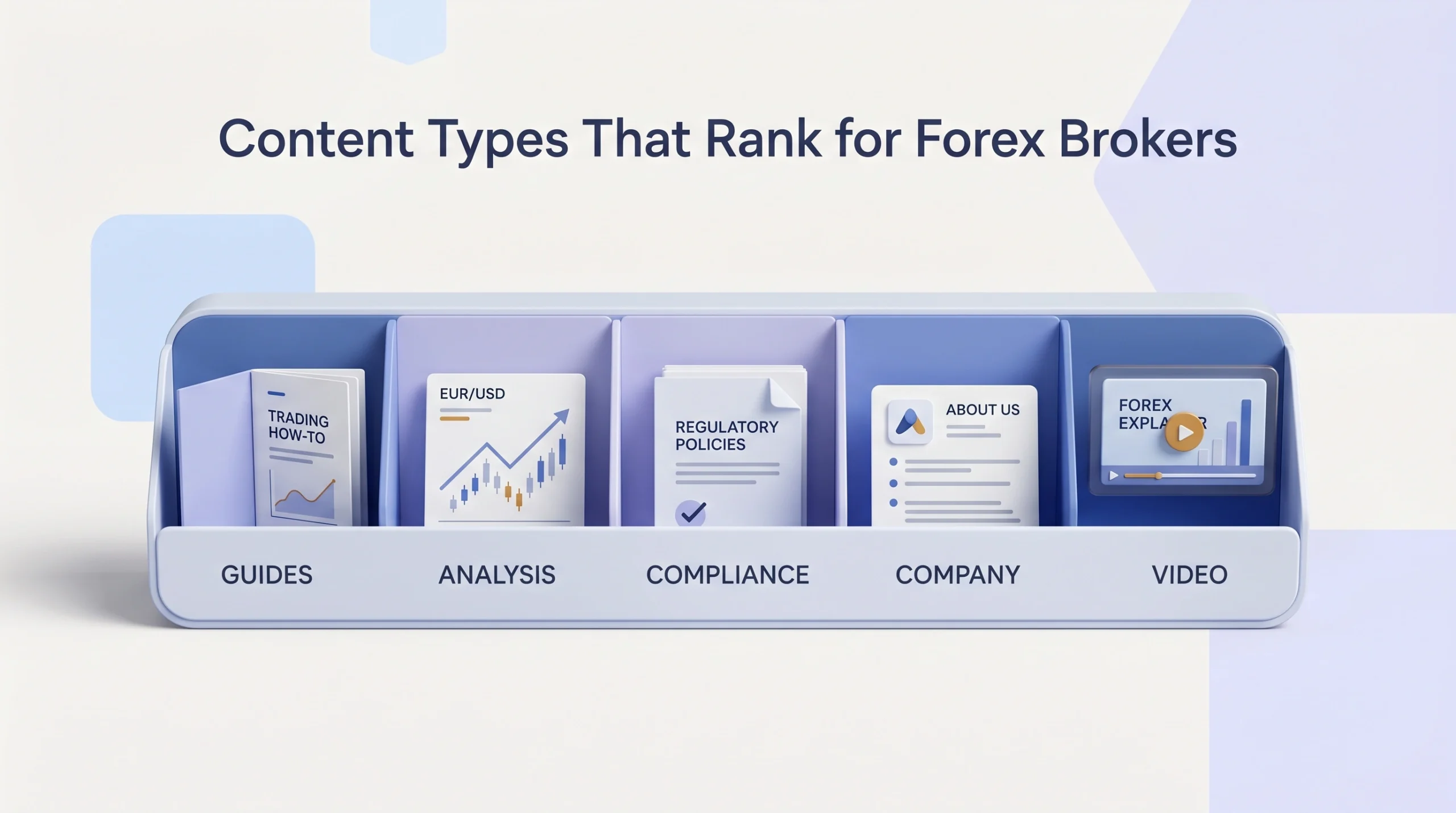
Different formats satisfy different intents. The best portfolio balances commercial pages, reference material, company information, analysis, and educational resources without allowing informational publishing to become an unrelated traffic project.
Broker Reviews and Comparisons
A brokerage should be cautious about publishing affiliate-style reviews or unsubstantiated competitor rankings. However, factual comparison resources can be appropriate when they explain technologies, account structures, execution approaches, or operational models without presenting a disguised recommendation.
A responsible comparison page should:
- Disclose the comparison methodology
- Use current, verifiable criteria
- Separate facts from editorial interpretation
- State important limitations
- Avoid selective or misleading data
- Include a revision date
- Provide a correction process
Broker technology providers can compare deployment models, integration methods, or infrastructure requirements. The purpose should be to help a business reader understand trade-offs, not to imitate a “best forex brokerage” affiliate page.
Regulation and Compliance Guides
Regulatory guides can earn visibility and references because requirements are complex and jurisdiction-specific. They also carry a high maintenance burden.
Every guide should identify:
- The jurisdiction and regulator
- The intended type of firm or audience
- The publication or rule being discussed
- The effective or review date
- Areas requiring professional legal interpretation
- Whether the page is general information rather than legal advice
Country-specific pages should be reviewed whenever rules, permissions, or risk-warning requirements change. Outdated compliance material can damage building trust and authority more severely than having no page at all.
Trading Education Content
Trading education can explain product mechanics, terminology, risk, and platform functionality. It should not become a library of unreviewed tactics created only to capture traffic for trading strategies.
A strong governance model separates:
- Neutral education from product promotion
- Historical examples from forward-looking claims
- Platform instructions from financial advice
- General risk explanations from personalized suitability
- Editorial content from sponsored or partner material
Well-researched education may support organic traffic and brand familiarity. Its value still depends on accuracy, reviewer expertise, and consistency with the company’s permissions and audience.
Forex Market Analysis
Market analysis can attract repeat visits and demonstrate expertise, but it is resource-intensive. Short-lived commentary may generate temporary impressions while creating a large archive of outdated pages.
Before launching daily analysis, define:
- Who will produce and approve it
- Which instruments and markets will be covered
- How facts and data will be sourced
- Whether opinions are clearly attributed
- Which disclaimers are required
- How expired analysis will be archived or updated
- How performance will be assessed beyond page views
Evergreen methodology pages can complement time-sensitive reports. They explain how data is collected, how terms are defined, and what limitations apply.
Operator and Company Content
Entity, leadership, governance, infrastructure, and operational pages are central to authority and trust. They help users verify who is behind a brand and can support branded search results.
Useful company content includes:
- Legal entity and licence information
- Leadership biographies
- Office and support details
- Corporate governance information
- Security and resilience practices
- Execution or pricing methodology
- Conflict-of-interest policies
- Complaints and escalation processes
- Press contacts and media resources
These pages should be easy to locate. Hiding substantive trust information in a footer PDF or registration flow creates friction for users and search systems.
Multimedia Content for Trader Engagement
Video, diagrams, webinars, and interactive tools can make complex subjects easier to understand. They should supplement rather than replace accessible written information.
For stronger search visibility:
- Give every important video a descriptive page
- Add an accurate transcript
- Summarize the main points in text
- Label presenters and reviewers
- Provide captions
- Compress media files
- Add appropriate structured data
- Avoid autoplay that disrupts mobile use
Engaging content should still be purposeful. A high video completion rate is useful only when the material supports understanding, product adoption, or another defined business objective.
On-Page SEO for Forex Websites

On-page SEO is essential because it establishes what each page covers, who it serves, and how its information is organized. It cannot compensate for weak evidence or poor positioning, but it helps strong pages communicate their relevance.
SEO-Friendly Title Tags
A title tag should identify the page’s specific subject and distinguish it from similar resources. It must also remain accurate enough to pass compliance and editorial review.
Effective patterns may combine:
- Primary topic
- Audience or use case
- Jurisdiction where necessary
- Product or platform context
- The brand name was useful
Avoid loading titles with repeated commercial terms. A concise title such as “Forex CRM Integration Guide for Broker Operations” is clearer than a string of loosely related phrases.
Effective Meta Descriptions
Meta descriptions do not need to contain every target term. Their purpose is to set an accurate expectation and encourage a qualified click.
A useful description should explain:
- What the page covers
- Who it is for
- What practical value does it provide
- Any important geographic or product limitation
Descriptions should not promise profits, guaranteed outcomes, or capabilities that the page does not demonstrate. Google may generate a different snippet when the page content better matches the query.
Forex Keyword Placement
Keywords should appear where they improve clarity: the title, main heading, introduction, relevant subheadings, body copy, image descriptions, and internal links. They should not be repeated according to a rigid formula.
Use forex language precisely. “Forex platform infrastructure” and “forex trading education” describe different intents and should not be treated as interchangeable. Search engine optimization works best when terminology reflects the actual page’s purpose.
Warning signs of over-optimization include:
- Awkward exact-match repetition
- Several headings say nearly the same thing
- Generic paragraphs added only for word count
- Unnatural anchors
- Duplicate regional copy
- Pages created for minor keyword variations
- Footers filled with location and product terms
Current SEO practice prioritizes useful distinctions over mechanical density. Search engines should not have to choose between several nearly identical pages.
SEO-Friendly URL Structure
URLs should be short, stable, descriptive, and aligned with the site hierarchy. Avoid unnecessary parameters, dates on evergreen pages, and deeply nested folders.
A clear structure might separate:
- Platform and product pages
- Educational resources
- Regulatory information
- Regional content
- Research and analysis
- Company information
- Technical documentation
Changing established URLs requires redirects, updated internal links, and monitoring. Frequent restructuring can weaken accumulated signals and create avoidable crawl errors.
Header Hierarchy and Internal Links
Each page should normally have one clear H1 followed by logically nested H2 and H3 headings. Headings should describe sections rather than act as containers for repeated keywords.
Internal links belong where they answer the reader’s next likely question. A regulation guide may link to entity information, while a platform article may link to technical specifications or onboarding documentation.
A well-optimized page remains understandable when skimmed. Its headings, table labels, lists, and links should reveal the argument without relying on promotional filler.
Technical SEO and User Experience

Technical SEO ensures that important pages can be discovered, rendered, indexed, and used efficiently. In financial services, technical problems may also weaken trust when forms fail, layouts shift, or regional users encounter inconsistent information.
Mobile Optimization and Responsive Design
Google uses mobile-first indexing, so the mobile version should contain the same essential information, internal links, metadata, and structured data as the desktop experience.
Test important templates on real devices, including:
- Homepage and regional landing pages
- Product pages
- Registration and login routes
- Funding or account information
- Long-form resources
- Tables and comparison pages
- Embedded charts and videos
- Cookie and risk-warning interfaces
Mobile optimization is not limited to responsive dimensions. Forms, warnings, navigation, language selectors, and support options must remain readable and usable without accidental taps or hidden text.
Core Web Vitals and Page Speed
Google describes Core Web Vitals as real-world measures of loading performance, responsiveness, and visual stability. Its documentation recommends achieving good results while considering the broader page experience.
Common performance problems on broker websites include:
- Heavy trading widgets are loaded on every page
- Multiple tag-management scripts
- Oversized hero videos
- Unoptimized language and geolocation tools
- Third-party chat applications
- Layout shifts caused by banners
- Large JavaScript frameworks
- Slow consent-management platforms
Performance work should prioritize templates generating meaningful search traffic or conversions. Removing a decorative script from a major landing-page template may have greater value than perfecting an isolated article.
Crawlability and Indexation
A page cannot generate SEO results if search engines cannot access, render, or index it correctly. Regular technical reviews should identify blocked resources, accidental noindex tags, redirect chains, canonical conflicts, duplicate URLs, soft errors, and JavaScript rendering problems.
Indexation decisions should be intentional. Pages that may not belong in search include:
- Internal account areas
- Thin campaign variations
- Duplicate tracking URLs
- Empty search results
- Expired promotions
- Unavailable regional pages
- Test environments
- Parameter combinations with no unique value
Google’s spam policies warn against practices intended to manipulate search systems, including scaled low-value publishing and other deceptive methods.
XML Sitemaps and Robots.txt
XML sitemaps should contain canonical, indexable URLs that the organization considers valuable. Separate sitemaps can help teams monitor products, resources, regional pages, videos, or news content.
Robots.txt controls crawling rather than guaranteed index removal. Sensitive or private information needs proper authentication, not only a disallow rule.
Review these files after:
- Platform migrations
- Domain or subdomain changes
- Regional expansion
- Content-management system updates
- Large-scale redirects
- Navigation redesigns
- New rendering technology
- Security or staging incidents
Sitemaps and robots directives should reflect the current site, not assumptions left over from a previous architecture.
E-E-A-T, Trust, Compliance for Forex Brokers
Building trust and authority requires visible evidence of experience, expertise, accountability, and operational legitimacy. Generic author labels and boilerplate disclaimers rarely provide enough context for financially sensitive material.
Expert Authors and Reviewer Profiles
Author profiles should explain why the person is qualified to cover the subject. Relevant experience may come from brokerage operations, compliance, product management, market structure, technology, legal practice, or financial journalism.
Profiles can include:
- Current role and responsibilities
- Relevant professional history
- Specialist subjects
- Qualifications where applicable
- Links to other reviewed work
- Editorial or compliance responsibilities
- A professional contact or verification route
Do not invent credentials or exaggerate involvement. When an article is drafted by a writer but technically reviewed by a specialist, state both roles clearly.
Editorial Policies and Content Accuracy
An editorial policy should explain how topics are selected, how claims are checked, who reviews sensitive pages, and how corrections are handled.
A practical governance framework includes:
- A content brief defining the audience and intent
- Evidence requirements for factual claims
- Product and subject-matter review
- Compliance review, where necessary
- Publication approval
- Scheduled revision dates
- A process for urgent corrections
- Change records for regulated or high-impact pages
Well-researched material can still become inaccurate as products and rules change. Revision should be based on risk and volatility rather than applying the same schedule to every page.
Risk Disclosures and Regulatory Information
Disclosures should be prominent enough to support understanding and should match the page’s jurisdiction, audience, product, and purpose. They should not be treated as a universal paragraph appended after aggressive claims.
Paid and organic journeys must also be coordinated. Google’s policy for complex speculative financial products limits eligibility and may require certification for products such as rolling spot forex and CFDs in approved locations. Organic visibility does not remove advertising, licensing, or local legal obligations.
Review risk and regulatory information across:
- Search snippets and landing pages
- Forms and onboarding flows
- Videos and webinars
- Social posts
- Email campaigns
- Affiliate or introducing-broker materials
- Downloadable documents
- Translated pages
- Structured data fields
Consistency matters. Conflicting entity names, outdated licence references, or different warnings across channels can weaken credibility and create compliance concerns.
Geo-Targeting and Local SEO
International operators should not assume that one English-language website can serve every market equally. Geo-targeting requires decisions about eligibility, regulation, language, payment methods, product availability, and audience expectations.
Regional Landing Pages
A regional page should offer substantial local value. Replacing a country name while preserving identical body copy creates weak differentiation and may confuse users.
Useful regional information can cover:
- Available legal entity
- Applicable regulator
- Product availability
- Account eligibility
- Supported funding methods
- Local currency options
- Customer support language and hours
- Relevant warnings
- Contact information
- Regional platform limitations
Pages should not be indexable when the business does not accept or serve the audience implied by the page.
Local Forex Keyword Targeting
Local keyword research should examine how users describe products, legal entities, platforms, and operational questions within specific geographic markets. Literal translation may miss common terminology or create the wrong search intent.
Regional research can combine:
- Country-filtered search data
- Local search result analysis
- Input from native-speaking product teams
- Customer support language
- Competitor terminology
- Regulator vocabulary
- Paid-search query data where permitted
The objective is not to insert every country variation. It is to identify genuine differences that justify dedicated information.
Localization Beyond Direct Translation
Localization should adapt meaning, not merely words. Currency formats, legal terminology, examples, date formats, risk warnings, interface labels, and calls to action may all need adjustment.
A strong workflow uses native-language reviewers who understand both the product and financial context. Machine translation may support initial production, but sensitive pages require human validation.
Check localized content for:
- Terminology consistency
- Regulatory accuracy
- Cultural clarity
- Correct entity references
- Interface alignment
- Local contact details
- Natural search phrasing
- Appropriate examples
Translation quality affects more than search engine rankings. Awkward or inconsistent language can undermine confidence at the point of evaluation.
Country-Specific Compliance Content
Country pages should distinguish between globally relevant information and jurisdiction-specific obligations. Avoid implying that one regulator’s rules apply universally.
A compliance content matrix can record:
| Field | Purpose |
| Country and language | Defines the intended audience |
| Operating entity | Identifies the contracting business |
| Regulatory status | Records applicable permissions |
| Available products | Prevents misleading global claims |
| Required warnings | Supports local review |
| Restricted claims | Guides writers and campaign teams |
| Reviewer and date | Establishes accountability |
| Source documentation | Supports future updates |
This matrix can reduce errors across content, paid media, social campaigns, and partner materials.
Hreflang Implementation
Hreflang helps search engines understand language or regional alternatives. It should be implemented only when corresponding pages genuinely exist and return valid, indexable responses.
Common errors include:
- Missing return annotations
- Incorrect language-country codes
- Canonical tags pointing to another region
- Links to redirected or non-indexable pages
- Automatic redirection that prevents access
- Mixing language and country targeting without a plan
- Omitting the general-language fallback where appropriate
Large implementations should be generated systematically and validated through crawls. Manual maintenance becomes unreliable across hundreds of pages.
Off-Page SEO, Backlinks, Community Authority
Off-page growth should focus on earning legitimate recognition from relevant organizations and publications. One contextual backlink from a reputable financial or technology source may have more strategic value than hundreds of unrelated directory entries.
Digital PR Using Proprietary Forex Data
Original data can create a defensible reason for journalists, researchers, and industry publications to reference a company. Suitable projects may analyze platform usage, execution infrastructure, operational trends, support demand, or regional technology adoption.
A credible research asset should explain:
- What data was used
- How it was collected
- The period covered
- Whether the sample is representative
- How calculations were performed
- What limitations apply
- Who reviewed the findings
- Which conclusions are supported
Do not publish selective statistics designed to imply trading outcomes. Proprietary research should inform the market without creating a misleading commercial claim.
Outreach to Financial Publications
Outreach works when the proposed contribution fits the publication’s audience and editorial standards. Generic requests for links usually fail because they offer no editorial value.
Potential contributions include:
- Commentary from a qualified executive
- Technical explanations
- Regulatory implementation insights
- Original research
- Operational case studies
- Data visualizations
- Expert responses to industry developments
Evaluate opportunities by relevance, editorial credibility, audience fit, and permanence. Traffic estimates alone do not determine whether a placement strengthens the brand.
Strategic IB and Affiliate Partnerships
Introducing broker and affiliate relationships can support distribution, but they also create oversight requirements. Partners should not be encouraged to make claims that the regulated business could not publish itself.
SEO teams should work with compliance and partnership managers to define:
- Approved terminology
- Permitted landing pages
- Disclosure requirements
- Brand bidding rules
- Content review procedures
- Prohibited claims
- Monitoring expectations
- Correction and termination processes
Link building should never become the sole justification for a partnership. The relationship needs genuine commercial and audience value.
Forum and Trading Community Presence
Communities can reveal recurring questions, terminology, objections, and product issues. Participation should be transparent and useful rather than disguised promotion.
Good community practice includes:
- Identifying company representatives
- Answering operational questions accurately
- Avoiding investment or trading advice
- Escalating account-specific issues privately
- Correcting misinformation with evidence
- Recording recurring questions for future content
- Respecting platform rules
- Avoiding manufactured endorsements
Community mentions may support discovery and reputation even when links do not directly influence rankings. They can also expose gaps between marketing messages and customer experience.
Forex SEO Performance, Costs, FAQs
SEO efforts should be evaluated as a portfolio of technical, editorial, authority, and conversion improvements. No single metric proves success, and no provider can responsibly guarantee rankings, traffic, leads, deposits, or revenue.
Brokers can monitor rankings through Google Search Console and reputable rank-tracking platforms, segmented by country, language, device, page, and query type. Rankings should be interpreted alongside impressions, click-through rate, indexed-page coverage, and competitor movement. Because results vary by location and personalization, isolated manual searches are unreliable. Reporting should emphasize sustained visibility across commercially relevant topic groups rather than one headline keyword.
Useful metrics include qualified organic sessions, non-brand visibility, assisted conversions, registration starts, verified leads, partner enquiries, engagement with decision-stage pages, and conversion quality by market. Teams should also monitor bounce rates carefully because their meaning depends on the page’s purpose. A single-answer guide may satisfy users without a second page view, while abandonment during onboarding often indicates a more serious problem.
Costs depend on the number of markets, languages, templates, technical problems, content requirements, compliance reviews, and authority-building goals. A limited technical audit requires a different investment from an international program combining research, publishing, digital PR, localization, and analytics. Decision-makers should compare scope, senior involvement, deliverables, governance, and measurement methodology rather than selecting a provider solely by the lowest monthly fee.
Timelines vary according to domain history, competition, technical condition, publishing capacity, market focus, and existing authority. Technical fixes may be processed relatively quickly, while topical authority and reputable references usually require sustained work. SEO requires ongoing measurement because search results, competitors, regulations, and audience expectations change. Responsible planning should use milestones for implementation and leading indicators rather than promise a fixed ranking date.
AI-generated search experiences increase the importance of clear entities, concise explanations, verifiable facts, expert attribution, structured content, and consistent brand information. Pages should answer specific questions directly while providing enough evidence for validation. Structured data may help systems interpret page elements, but it does not guarantee citation. Brands should monitor referral patterns, branded searches, mentions, and visibility across conventional and AI-assisted discovery environments.
Common failures include publishing generic articles at scale, copying competitor structures, targeting unavailable countries, separating SEO and compliance, buying irrelevant backlinks, and creating multiple pages for minor keyword variations. Other weak marketing strategies focus on traffic without measuring lead quality or business relevance. Long-term growth is more likely when the program combines distinctive expertise, technical reliability, editorial governance, market-specific execution, and realistic performance evaluation.