


Tell us about your goals and we’ll create a custom PBN backlink strategy that drives real rankings and long-term growth.

Mon-Fri: 09:00 AM – 06:00 PM
Generating a dependable flow of new prospects in the forex industry requires more than buying contact lists or increasing advertising spend. A brokerage must connect audience research, search visibility, paid acquisition, partner management, website performance, compliance controls, and sales follow-up into one measurable system. Each component should support the same commercial objective: attracting and converting suitable potential clients without creating misleading expectations.
Forex Lead Definition, Types, and Qualification Criteria
A forex lead is an individual or business contact who has shown an identifiable interest in a broker, trading platform, liquidity service, white label platform, or related product or service. That interest can range from reading educational materials to requesting a demo, beginning registration, or asking about white-label solutions.
Marketing-Qualified vs Sales-Qualified Forex Leads
A marketing-qualified lead has completed an action that suggests relevant interest but may not yet be ready for direct sales engagement. Examples include subscribing to a newsletter, attending forex webinars, downloading market analysis, or repeatedly visiting account-related pages.
A sales-qualified lead has passed additional checks, indicating stronger commercial intent. Depending on the business, those checks may include location, product eligibility, company type, expected trading volume, preferred technology, or readiness to speak with a representative.
A useful qualification framework considers:
- Demonstrated intent: Content viewed, forms completed, questions asked, and return visits
- Commercial fit: Budget, business model, anticipated activity, or account requirements
- Geographic eligibility: Residence, operating jurisdiction, and permitted product access
- Engagement stage: Researching, comparing, registering, verifying, or ready to deposit
- Contactability: Valid details, consent status, preferred channel, and response history
Sales and marketing should document when a contact moves between stages. Without shared definitions, marketing may report strong volume while sales see mostly unresponsive or unsuitable inquiries.
Organic, Paid, Affiliate, and Purchased Leads
Lead source affects cost, intent, control, and risk. Organic inquiries often arrive through a search engine after a prospect has actively researched a problem. Paid leads can be generated faster, but their quality depends on targeting, message accuracy, landing page relevance, and advertising restrictions.
Affiliate traffic can support scale when partners reach audiences that a brokerage cannot access efficiently on its own. Purchased databases offer less control because consent, recency, source transparency, and geographic accuracy may be difficult to verify.
| Lead source | Typical strength | Main limitation | Priority control |
| Organic search | Active research intent | Requires sustained authority building | Query and landing page relevance |
| Paid media | Faster testing and reach | Policy, cost, and creative constraints | Qualification and conversion tracking |
| Affiliates and IBs | Access to established communities | Variable traffic quality | Attribution and partner governance |
| Social and creators | Trust transfer and audience access | Message control can be difficult | Approval and disclosure workflows |
| Purchased leads | Immediate contact volume | Consent and intent may be weak | Source validation and suppression rules |
Lead Quality, Intent, Eligibility, and Geographic Fit
High-quality forex leads combine relevant intent with operational eligibility. A person may show interest in forex trading but still be unsuitable because the firm cannot serve the location, the requested product is unavailable, or the contact does not complete the required checks.
Lead scoring should use both positive and negative signals. Repeated visits to pricing, account, integration, or demo pages may support a higher score. Disposable email addresses, mismatched location data, duplicate submissions, unrealistic answers, or rapid form completion may indicate poor quality or invalid traffic.
A scoring model can include:
- Assign points for high-intent page visits and completed forms.
- Add fit criteria such as geography, company type, and requested solution.
- Reduce scores for missing details, duplication, or suspicious behaviour.
- separate the engagement score from regulatory eligibility.
- Review outcomes against activated accounts rather than form submissions alone.
This approach helps teams prioritise high-quality forex leads while preventing automated scoring from treating every inquiry as equally valuable.
Target Audience, Trader Personas, and Acquisition Goals
Effective forex broker marketing begins with specific audience definitions. Broad labels such as “new traders” or “fintech companies” provide too little direction for keyword selection, campaign targeting, content planning, or sales qualification.
Ideal Customer Profile for Forex Brokers
An ideal customer profile describes the audience a business can serve responsibly and profitably. For a forex brokerage, relevant factors may include jurisdiction, experience level, language, preferred asset classes, expected funding range, and platform requirements. For a B2B provider, the profile may focus on licensed firms, startup brokerages, prop businesses, or established operators seeking new infrastructure.
The profile should influence:
- Website positioning and value propositions
- Search topics and educational resources
- Paid campaign exclusions and geographic settings
- Product demonstrations and sales scripts
- Onboarding requirements and support capacity
- Metrics used to evaluate acquisition quality
Audience Segmentation by Experience, Geography, and Product Needs
Segmentation should reflect meaningful differences in intent rather than superficial demographic categories. Someone researching a forex trading tutorial has different needs from an experienced user when comparing execution features. A startup evaluating a white-label solution requires different evidence from an established brokerage seeking additional liquidity connections.
Useful segments may include:
- Prospects researching how an account works
- Experienced users evaluating costs, tools, or execution
- Users interested in copy trading or social trading features
- Inactive registrants who have not completed verification
- Broker founders assessing a white-label platform
- Operations teams reviewing CRM, onboarding, or risk systems
- Partners considering affiliate or introducing broker relationships
Geographic segmentation is equally important. Language adaptation alone is not enough. Product availability, required disclosures, accepted payment methods, cultural expectations, advertising rules, and customer support coverage can vary by location.
Search Intent, Pain Points, and Conversion Triggers
Search intent shows what a prospect is trying to accomplish. Informational searches may concern terminology, platform functionality, compliance processes, or operational setup. Commercial searches often include words related to providers, integrations, pricing, demos, or comparisons.
Google recommends creating helpful, reliable, people-first content rather than pages designed primarily to manipulate rankings. For financial businesses, this means answering the actual question, naming limitations, identifying the responsible author or reviewer, and avoiding unsupported performance claims.
Conversion triggers vary by segment but often include:
- Clear explanation of account or service requirements
- Evidence that the business serves the prospect’s jurisdiction
- Transparent next steps and expected documentation
- Relevant platform screenshots or workflow demonstrations
- Access to subject matter experts
- Responsive sales or customer support
- Credible information about security, licensing, or operations
Content should help potential clients make informed decisions. It should not push every visitor toward the same call to action regardless of intent.
Forex Lead Generation Funnel and Conversion Journey
A lead funnel maps how anonymous visitors become identifiable prospects, applicants, activated clients, or commercial partners. It should reveal where interest is created, where friction appears, and where leads stop progressing.
Awareness Channels and Lead Capture Points
Awareness can begin through organic search, LinkedIn, groups and forums, webinars, affiliates and IBs, paid media, industry events, newsletters, or direct referrals. Each channel creates different expectations.
Lead capture should match the stage of the journey. A visitor reading an educational article may respond to a newsletter or webinar invitation, while someone viewing implementation details may prefer a consultation or demo. Requiring a sales call for every resource can reduce inbound leads and produce incomplete forms.
Common capture points include:
- Newsletter subscriptions
- Educational resource downloads
- Webinar registrations
- Demo and platform access requests
- Partnership applications
- Account registration forms
- Contact and callback requests
Every form should collect only the information needed for the next action. Additional qualification can occur later through progressive profiling, CRM enrichment, or assisted follow-up.
Educational Lead Magnets, Webinars, Guides, and Demo Funnels
Educational materials can attract forex leads when they address real operational or decision-making questions. For retail acquisition, topics might explain account processes, platform functions, risk disclosures, or product terminology without providing investment advice. For B2B audiences, content may cover brokerage setup, technology evaluation, data workflows, liquidity operations, or regulatory planning.
Forex webinars work best when they have a defined audience and outcome. A generic session about the forex market may attract broad interest but produce weak qualifications. A focused webinar on onboarding optimisation, CRM architecture, or launching a regulated brokerage can create fewer but more relevant trading leads or business inquiries.
A simple content funnel can follow this sequence:
- Publish a specific guide aligned with a high-intent keyword.
- Offer a related checklist, webinar, or demo.
- Ask for role, location, and business need during registration.
- Send contextual email marketing based on the selected interest.
- Route engaged contacts to an appropriate specialist.
- Measure movement into qualified and activated stages.
The objective is not to collect as many email addresses as possible. It is to create a useful path from information needs to commercial conversation.
Registration, Verification, and Account Activation
Registration is not the end of lead generation. In many broker funnels, the largest commercial gap appears between form completion and account activation. Long forms, unclear documentation, technical errors, delayed follow-up, and weak mobile usability can prevent interested users from progressing.
Teams should monitor each transition:
- Landing page visit to form starts from the start to registration completion
- Registration for identity verification
- Verification of account approval
- Approval for funding or a commercial agreement
- Activation of continued trading activity
The same principle applies to B2B inquiries. A demo request may stall because the prospect receives a generic response, cannot identify implementation requirements, or waits too long for technical answers.
Channel-Specific Funnel Design
A single funnel rarely works equally well for every source. Paid search visitors often expect immediate relevance because they responded to a specific query. LinkedIn audiences may need more evidence before requesting a meeting. Affiliate referrals may arrive with expectations created by a partner, while cold leads require additional context and trust.
Website and Landing Page Optimisation for Forex Leads
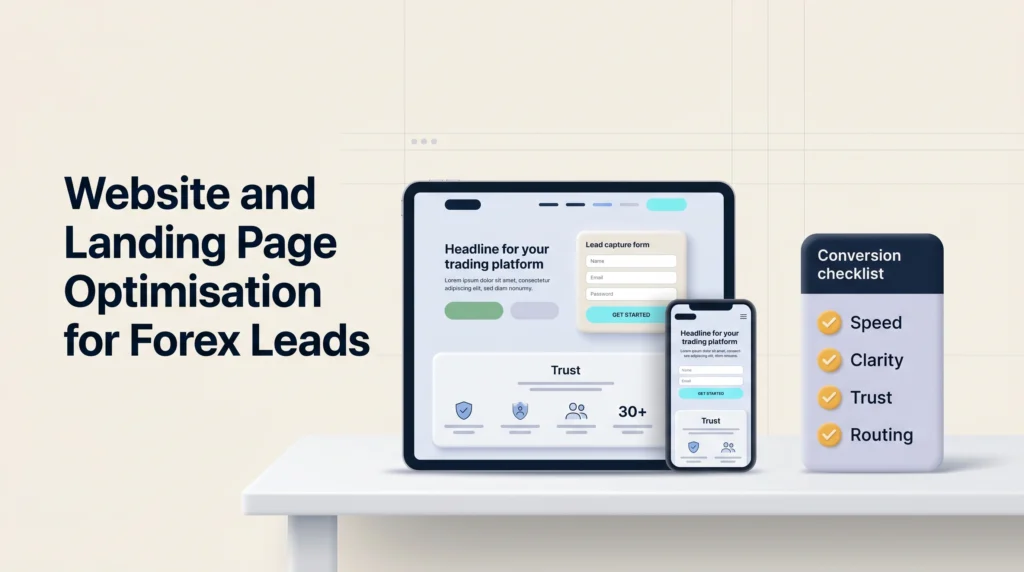
A website should reduce uncertainty while helping qualified visitors take an appropriate next step. Visual polish matters, but clear information architecture, technical reliability, message consistency, and accurate disclosure have greater influence on converting leads.
Fast Mobile Experience and Clear Navigation
Many visitors will first encounter a financial brand on a mobile device. Slow loading, intrusive overlays, unstable layouts, or difficult forms can undermine trust before the offer is evaluated.
Navigation should make important information easy to locate:
- Products and account or service options
- Platform functionality
- Company and regulatory information
- Costs, terms, and disclosures
- Educational materials
- Support and contact routes
- Partnership or B2B solutions
A scalable site architecture also helps a search engine interpret relationships between services, educational pages, location-specific resources, and company information. Avoid creating dozens of near-identical pages for minor keyword variations.
High-Converting Forms and Calls to Action
Calls to action should describe what happens next. “Request platform demo,” “Discuss brokerage infrastructure,” or “Continue account registration” is clearer than “Get started” when the process involves multiple steps.
Form design should balance qualification with effort. A B2B liquidity inquiry may justify fields for jurisdiction, company stage, asset coverage, or anticipated trading volume. A newsletter form usually needs less information.
Test practical variables such as:
- Number and order of fields
- Required versus optional information
- Mobile input behaviour
- Error messages and validation
- Consent wording
- Call-to-action specificity
- Confirmation page instructions
Conversion rate improvements are useful only when downstream quality remains stable. Removing essential qualification fields may increase submissions while reducing sales efficiency.
Trust Signals, Platform Proof, and Broker Credentials
Financial websites need verifiable trust signals. Generic badges, vague claims, and anonymous testimonials can weaken credibility. Stronger evidence includes clear company details, accurate regulatory information, named leadership, transparent policies, platform documentation, support routes, and content reviewed by subject matter experts.
A trading platform provider can also show integration workflows, security practices, service boundaries, product documentation, and realistic implementation considerations. A white-label provider should clarify what the package includes rather than describing every white-label solution as instantly deployable.
Trust is built through consistency. Advertising claims, landing pages, terms, and sales conversations should not contradict one another.
Live Support, Chatbots, and Assisted Conversion
Live chat and AI-powered assistants can answer routine questions, identify intent, and route visitors to relevant resources. They should not provide trading advice or interpret regulatory information. Escalation to a qualified person is essential when questions concern eligibility, agreements, account restrictions, or technical implementation.
Useful automation can:
- Identify language and broad inquiry type
- Provide approved answers to common operational questions
- Collect contact information with appropriate consent
- Schedule meetings in supported time zones
- Route partnership, support, and account inquiries separately
- Alert teams when high-intent visitors request assistance
Conversation records should feed into analytics and quality review. Repeated questions often indicate missing website content or confusing onboarding instructions.
CRM Integration and Lead Routing
CRM integration connects acquisition data with sales and account outcomes. Without it, teams may optimise for inexpensive form submissions that never convert.
Lead routing rules should consider location, language, product interest, lead score, consent, and business hours. Fast response may support conversion in specific scenarios, but speed should not replace relevance. A prospect asking about solutions for forex broker infrastructure should reach a B2B specialist rather than a general retail support queue.
Maintain consistent source, campaign, and partner identifiers across forms, CRM records, analytics platforms, and account systems. This makes it possible to compare channels using activated accounts and long-term value rather than headline lead volume.
Organic Lead Generation Through SEO and Content

Organic acquisition can create compounding visibility when a site addresses relevant questions, demonstrates expertise, and earns recognition across its subject area. It is not a shortcut, and publishing large volumes of generic text rarely creates durable authority.
Targeting High-Intent Forex Search Queries
Keyword research should distinguish informational demand from commercial intent. “What is a liquidity bridge?” signals a different need from “liquidity provider for forex brokerage.” Both can matter, but they require different pages and conversion paths.
A practical search framework includes:
- Map queries to audience roles and funnel stages.
- Separate retail, B2B, technical, regulatory, and support intent.
- Review current search results for format and depth expectations.
- Group related questions into coherent topic clusters.
- Assign one primary purpose to each page.
- Connect informational pages to relevant next steps.
Do not force phrases such as forex advertising or forex marketing strategy into pages where they do not belong. Search visibility depends on usefulness, technical accessibility, authority, and relevance, not keyword repetition alone.
Educational Content and Lead Magnets
Educational content should solve a defined problem and demonstrate practical knowledge. A brokerage might publish material about platform access, verification, risk controls, or account processes. A technology provider could cover automation, back-office workflows, white-label solutions, CRM selection, or liquidity integration.
Google’s guidance for AI features and website content reinforces the importance of accessible, useful pages rather than a separate technical trick for AI search visibility. Clear definitions, concise answers, original examples, logical headings, and identifiable expertise can make information easier for both people and retrieval systems to interpret.
Lead magnets should extend the page rather than repeat it. Useful formats include:
- Implementation checklists
- Decision frameworks
- Webinar recordings
- Requirements templates
- Platform evaluation worksheets
- Research summaries
- Operational planning guides
A lead magnet should state who it is for, what it covers, and what communication follows the download.
Turning Organic Traffic Into Enquiries and Registrations
Organic visitors should not all receive the same offer. A user reading an introductory article may be interested in a newsletter or related guide. A decision-maker reading an integration page may be prepared to request a technical discussion.
Contextual calls to action can improve relevance:
- Educational page for the related guide
- Regulatory page to compliance checklist
- Technology article to platform demonstration
- Partner content to affiliate application
- Account help page to assist with onboarding
- B2B solution page to consultation request
Measure assisted conversions, not only last-click registrations. Organic content often introduces the brand before another channel completes the conversion.
Building Search Visibility and Brand Trust
Search authority develops through useful coverage, technical quality, credible authorship, and external recognition. Publish content that reflects first-hand business knowledge, such as implementation trade-offs, anonymised workflow examples, original research, or expert commentary.
Google’s Search Essentials recommends using terms people search for in prominent page locations while maintaining helpful, reliable content. A strong editorial process should combine search data with compliance review, expert input, fact checking, and scheduled updates.
Avoid producing interchangeable articles across dozens of locations or products. A smaller library of accurate resources can build trust more effectively than a large archive of thin pages.
Paid Advertising, Social Media, and Influencer Acquisition

Paid channels can test messages and reach defined audiences faster than organic acquisition. However, forex advertising operates within platform policies, local regulations, licensing requirements, and product-specific restrictions.
Paid Search, Display, Native, and Social Campaigns
Paid search can capture explicit demand, while display, native, and social media may support awareness and retargeting. Each channel should have its own success criteria.
Google classifies CFDs, financial spread betting, and rolling spot FX as complex speculative financial products. Eligibility can depend on advertiser licensing, approved locations, certification, local law, and destination quality. Campaign planning should begin with policy and legal review rather than attempts to bypass platform controls.
A channel plan should document:
- Permitted products and locations
- Required advertiser approvals
- Audience exclusions
- Approved creative claims
- Landing page disclosures
- Tracking and consent requirements
- Review responsibilities
Media availability can change. A diversified acquisition mix reduces dependence on one platform or campaign type.
Campaign and Landing Page Message Alignment
An ad should lead to a page that directly supports its promise. Sending a B2B prospect interested in a white-label platform to a general homepage creates unnecessary friction. Promoting an educational webinar and then presenting an immediate deposit-focused page also breaks expectations.
Alignment should cover the audience, offer, terminology, location, and next action. It can help improve conversion quality because prospects receive the information they expected rather than a broader sales pitch.
Influencer and Creator Partnerships
Creators can transfer attention and credibility, but the relationship introduces message-control and compliance risks. Audience size should not be the main selection criterion. Review geographic reach, engagement quality, subject relevance, historic claims, disclosure practices, and the creator’s ability to follow an approval process.
The FCA’s social media financial promotions guidance states that promotions must remain fair, clear, and not misleading, including across formats such as short-form posts. Requirements vary by jurisdiction, so legal and compliance teams should approve the operating framework.
Creator governance should include:
- Written content and audience restrictions.
- Pre-approval for promotional material.
- Required disclosures and risk information.
- Prohibited claims and terminology.
- Monitoring of published and edited content.
- Removal and escalation procedures.
A creator relationship should be evaluated through qualified outcomes and conduct quality, not views alone.
Audience Targeting, Geographic Restrictions, and Compliance
Campaign settings should reflect where the business is authorised or otherwise permitted to market. Location controls are not always perfect, so teams may need additional landing page checks, IP signals, self-declared residence, and CRM suppression.
Targeting based on demographics or behavioural data should be reviewed for fairness, relevance, and privacy implications. Groups and forums also require care; community participation should provide useful information rather than disguised promotion.
Offshore operations may face different rules, but offshore status does not remove advertising platform restrictions or obligations in the countries where audiences are reached.
Measuring Lead Quality Across Paid Channels
Cost per lead is an early indicator, not a final decision metric. Compare media sources using qualified, verified, activated, and retained outcomes.
A paid media dashboard can include:
- Click-to-form conversion rate
- Valid contact rate
- Geographic eligibility rate
- Qualification rate
- Verification completion
- Cost per activated account
- Duplicate and fraud rate
- Retention and long-term trader value
Campaigns with higher initial costs may create stronger economics if they produce more suitable prospects. Analytics should connect media data with CRM and account outcomes.
Affiliate Marketing and Introducing Broker Programs
Affiliates and IBs can provide access to established audiences, regional knowledge, and community relationships. They can also create reputational, regulatory, and data-quality exposure when controls are weak.
Affiliate Commission Models and Partner Terms
Common commercial structures include payment per qualified lead, payment per activated account, revenue share, or hybrid arrangements. The model should align partner incentives with sustainable client quality.
Terms should define:
- Qualified and rejected events
- Attribution windows
- Duplicate handling
- Restricted locations and channels
- Prohibited promotional methods
- Payment validation
- Brand and disclosure requirements
- Audit and termination rights
Paying only for volume can encourage low-intent traffic. Reward structures should account for validation, eligibility, and downstream behaviour.
IB Recruitment, Enablement, and Communication
Recruit partners whose audiences and methods fit the business. Recruitment can occur through industry networks, events, LinkedIn, referrals, and direct outreach. Screening should cover ownership, traffic sources, audience geography, promotional history, and related websites.
Partners need approved materials, accurate product information, campaign rules, and a reliable contact. Regular communication can keep your audience engaged indirectly because partners receive current resources rather than making claims.
Attribution, Tracking, and Lead Validation
Affiliate attribution should use consistent identifiers across landing pages, registration systems, CRM records, and account platforms. Tracking must also account for privacy controls, cross-device journeys, and duplicate applications.
Validation rules should be transparent. Partners should know why an event was rejected and how disputes are handled. Internal teams should compare attributed leads with account outcomes to identify partners that generate scalable value.
Partner Compliance, Fraud Prevention, and Traffic Quality
Partner monitoring should continue after approval. Risks include brand bidding, misleading claims, cookie stuffing, fabricated registrations, incentive abuse, duplicate leads, and traffic from restricted locations.
Warning signs may include:
- Sudden unexplained submission spikes
- Repeated device or network patterns
- High form completion with low response
- Mismatched location and language data
- Unapproved claims or creatives
- Concentrated activity at unusual times
- High activation followed by immediate inactivity
Compliance, partnership, analytics, and finance teams should share findings. Isolated reviews may miss patterns visible only across multiple systems.
Lead Nurturing, Retargeting, and Conversion Follow-Up
Not every suitable prospect converts during the first visit. Nurturing can support progression when messages remain relevant, permission-based, and aligned with the contact’s stage.
Email Sequences for New and Unconverted Leads
Email marketing should answer the next likely question rather than repeat the same sales message. Segment sequences by source, product interest, registration stage, location, and engagement.
A sequence may include:
- Confirmation and requested resource
- Explanation of relevant next steps
- Approved educational materials
- Answers to common operational questions
- Invitation to support, webinar, or demonstration
- Preference update or opt-out option
The UK ICO’s electronic marketing guidance explains that unsolicited electronic marketing can require specific consent depending on the recipient and context. Requirements differ across markets, so consent records and suppression rules should be designed for the jurisdictions involved.
Retargeting Across Search, Social, and Display
Retargeting can reconnect with visitors who viewed relevant pages without completing an action. Segments should be specific enough to support useful messaging. Someone who attended forex webinars should not automatically receive the same campaign as someone who abandoned identity verification.
Frequency controls, audience duration, exclusions, and sensitive-category policies matter. Remove converted users where appropriate and avoid messaging that reveals private financial activity on shared devices.
Registration and Verification Follow-Up
Application follow-up should identify the exact point of friction. Generic push notifications or repeated reminders may not help when a document was rejected, a page failed, or eligibility is unclear.
Useful follow-up can explain:
- Missing information
- Accepted document types
- Review status
- Security steps
- Support options
- Relevant deadlines
- How to resume the process
Automation should escalate complex cases to trained staff. Clear assistance can support onboarding without pressuring users to start trading or depositing before required checks are complete.
Reactivating Abandoned or Incomplete Applications
Reactivation should prioritise recent, eligible contacts with identifiable barriers. Review behavioural and CRM data before launching a broad campaign.
Useful segments include incomplete registration, unfinished verification, missed demo, expired proposal, or inactive B2B discussion. Tailor the message to the last confirmed stage and stop communication when consent, eligibility, or relevance no longer applies.
Lead Economics, Compliance, and Performance Optimisation
Lead generation should be managed as an economic and operational system. Headline volume can hide high rejection rates, support costs, weak retention, and regulatory exposure.
Cost per Lead and Cost per Activated Account
Cost per lead equals acquisition spend divided by valid leads. Cost per activated account uses a later and more meaningful outcome. For B2B providers, the equivalent may be cost per qualified opportunity or signed client.
| Metric | Calculation | Management use |
| Cost per valid lead | Spending divided by valid inquiries | Early channel efficiency |
| Cost per qualified lead | Spending divided by accepted prospects | Sales relevance |
| Cost per activated account | Spend divided by activated accounts | Acquisition economics |
| Verification completion rate | Completed checks divided by started checks | Onboarding performance |
| Partner rejection rate | Rejected events divided by submitted events | Traffic quality |
| Long-term value ratio | Client value divided by acquisition cost | Sustainable channel comparison |
Finance, marketing, sales, and operations should agree on metric definitions. Otherwise, each team may report a different version of performance.
Conversion Rate, Deposit Rate, and Lifetime Value
Conversion rate must always name its start and end points. Visitor-to-lead, lead-to-qualified, registration-to-verification, and verification-to-activation measure different parts of the journey.
Deposit rate can be commercially relevant for a forex brokerage, but it should not be interpreted without considering retention, complaints, trading activity, and support costs. A campaign that generates many first deposits but weak long-term engagement may be less valuable than a smaller channel producing a loyal client base.
Track cohort performance by:
- Source and campaign
- Partner or creator
- Geography and language
- Device and landing page
- Registration month
- Product interest
- Sales or support route
Cohort analysis can reveal whether apparent growth comes from genuine quality or short-lived volume.
Buying Forex Leads vs Generating Forex Leads
Purchased leads may provide immediate reach, but the buyer has less visibility into how interest and consent were obtained. Inbound leads generated through owned content or campaigns offer greater control, though they require investment in search visibility, media, technology, and editorial capability.
Before buying leads, assess:
- Original collection method
- Consent language and permitted recipients
- Age and exclusivity of records
- Geographic verification
- Replacement and rejection terms
- Data security arrangements
- Evidence of user intent
Generating leads in-house does not eliminate risk. Poor forms, misleading creative, weak analytics, or uncontrolled automation can still produce unsuitable contacts.
Lead Quality, Invalid Traffic, and Fraud Indicators
Invalid traffic can come from bots, incentivised users, duplicate submissions, dishonest partners, or measurement errors. Fraud controls should combine technical signals with operational review.
Useful controls include device analysis, velocity checks, duplicate detection, source consistency, email and phone validation, and manual review of unusual cohorts. Avoid relying on one score. Legitimate users can produce unusual signals, while sophisticated abuse may resemble normal behaviour.
Regulatory Rules, Consent, and Data Protection
Compliance should be built into campaign planning, not added after creative production. Requirements can affect claims, risk warnings, audience selection, landing pages, partner activity, data collection, and follow-up.
A practical review workflow includes:
- Confirm product and jurisdiction scope.
- Identify applicable regulatory and platform rules.
- Approve claims, disclosures, and target audiences.
- Document consent and lawful data use.
- Monitor live campaigns and partner content.
- Retain approval and version records.
- Escalate complaints, breaches, or unusual patterns.
No marketing strategy should assume that a channel available in one country is permitted in another. Legal advice and regulator-specific review may be necessary before launch.
FAQ
Forex brokers can generate qualified leads by defining eligible customer profiles, publishing intent-led content, using compliant paid media, developing controlled affiliate relationships, and improving registration follow-up. Quality depends on connecting source data with verification, activation, and retention outcomes. Campaigns should be evaluated by suitability and long-term value rather than form submissions alone.
Lead volume varies by jurisdiction, brand maturity, budget, product, and audience. Organic search, paid search, social media, affiliates, IBs, creators, webinars, and referrals can all contribute. The highest-volume channel is not necessarily the most valuable. Brokers should compare valid contact rate, eligibility, activation cost, retention, and compliance exposure across each source.
There is no universal realistic cost because pricing depends on geography, regulation, competition, audience criteria, channel, and qualification standards. A low-cost inquiry may be uncontactable or ineligible, while an expensive lead may progress further. Businesses should calculate the cost per valid, qualified, verified, and activated prospect before judging whether a campaign is economically sustainable.
Timelines depend on the channel and existing infrastructure. Paid campaigns and partnerships may begin producing inquiries quickly after approvals, while organic search and brand authority usually require sustained work. Even when leads arrive early, reliable conclusions need enough downstream data to assess verification, activation, retention, and quality. No responsible plan should promise a fixed result date.
Buying leads may provide immediate volume, but it creates questions about consent, exclusivity, recency, source transparency, and intent. In-house generation offers more control over messaging, targeting, data collection, and measurement, but requires greater capability. Many firms use a mixed model, testing external suppliers carefully while developing owned acquisition assets and strict validation rules.
AI can support segmentation, lead scoring, content research, chatbot routing, fraud detection, campaign analysis, and personalised follow-up. It should operate within approved rules, reliable data, human review, and privacy controls. AI-generated outputs can be inaccurate or inconsistent, so businesses should not use automation to provide trading advice, invent claims, or make unsupervised eligibility decisions.