


Tell us about your goals and we’ll create a custom PBN backlink strategy that drives real rankings and long-term growth.

Mon-Fri: 09:00 AM – 06:00 PM
A strong forex marketing strategy is not a collection of disconnected campaigns. It is an operating system that links market positioning, regulatory boundaries, customer acquisition, product experience, CRM, retention, analytics, and commercial priorities. For a forex brokerage, CFD provider, trading platform, or broker technology company, this system must also account for advertising restrictions, local licensing, reputational risk, and long decision journeys.
Forex Broker Marketing Strategy Fundamentals
A forex marketing strategy should translate commercial objectives into measurable priorities for acquisition, activation, and retention. It should also clarify what the marketing team will not pursue, particularly when resources, regulatory permissions, or operational capacity are limited.
Marketing Goals Across Launch, Growth, and Scale Stages
Marketing priorities change as a brokerage matures. A new FX brokerage may need to establish credibility, validate its positioning, and attract an initial group of new clients. A growing firm may focus on improving conversion rates, entering new regions, and expanding its marketing arsenal. A mature operator may place greater emphasis on brand awareness, partner efficiency, retention, and customer value.
Useful goals by stage include:
- Launch: Establish trust signals, clarify market positioning, build compliant landing pages, and test initial acquisition channels.
- Growth: Improve funded-account quality, develop an IB program, expand search visibility, and strengthen lifecycle communication.
- Scale: Allocate budgets using marginal returns, improve attribution, diversify channel exposure, and protect long-term relationships.
Building a Realistic Marketing Roadmap
A realistic roadmap sequences work according to dependencies. It makes little sense to scale paid search when website positioning is unclear, compliance review is inconsistent, or CRM events are unreliable. Similarly, investing heavily in educational content without a distribution plan may create a large publishing workload without producing meaningful visibility.
A practical roadmap can follow five stages:
- Audit positioning, audiences, regulatory scope, website performance, and measurement.
- Fix high-impact weaknesses in messaging, tracking, onboarding, and trust presentation.
- Build foundational channels such as search, content, CRM, and partner operations.
- Test paid and multi-channel campaigns with controlled budgets.
- Scale only after lead quality, operational capacity, and unit economics are validated.
Planning should include owners, dependencies, approval processes, measurement standards, and stop conditions. This prevents marketing costs from expanding faster than the organisation’s ability to assess traffic quality or serve acquired users.
Balancing Acquisition, Activation, and Retention
Acquisition receives attention because it is visible and easy to budget. However, a brokerage can generate many registrations while losing value through incomplete verification, weak onboarding, poor product communication, or irrelevant follow-up. Activation and retention must therefore be designed alongside campaign planning.
Teams should monitor the full progression:
- Qualified website visit
- Registration start
- Completed account application
- Verification completion
- First meaningful platform action
- Initial funding, where permitted and appropriate
- Continued product engagement
- Retention or reactivation
This framework helps a marketer distinguish channel problems from product or operational problems. If registrations are strong but verification completion is weak, buying more traffic may increase waste. If activation is healthy but retention falls quickly, the priority may be CRM, support, product education, or trading platform usability rather than additional forex advertising.
Market Positioning, Audience Research, and Compliance

Positioning determines why a specific customer segment should consider your business instead of another provider. Audience research identifies where that message should appear, while compliance defines how it may be communicated.
Competitive Positioning in Crowded Forex Markets
Generic claims rarely create durable differentiation. A spread, platform feature, or account benefit may be easy for competitors to replicate. Stronger positioning connects product capability with a defined business or customer context.
A brokerage might differentiate through:
- Regional expertise and local support
- Institutional or professional account infrastructure
- Technology designed for algo traders
- Transparent pricing and execution information
- Multi-asset access through one trading platform
- Partner services for IBs and broker networks
- Specialist onboarding for particular client profiles
Market size alone is not a positioning argument. The Bank for International Settlements reported that global OTC foreign exchange turnover averaged approximately $9.6 trillion per day in April 2025, but this daily trading figure covers a broad institutional market. It should not be presented as proof that any individual retail-focused brokerage will achieve rapid growth.
Audience Segmentation by Experience, Geography, and Needs
A target audience should be defined through commercial relevance, product fit, eligibility, needs, and likely behaviour. Basic demographics such as age or location may inform media planning, but they are not enough to shape persuasive B2B or customer-facing communication.
Useful segmentation dimensions include:
- Market status: Retail, professional, institutional, partner, or technology buyer
- Experience: New account applicant, experienced user, active participant, or algo trader
- Need: Platform access, execution infrastructure, reporting, localisation, or partner support
- Geography: Regulatory jurisdiction, language, payment environment, and cultural context
- Behaviour: Research activity, registration stage, product usage, or response to communication
A content journey for experienced forex traders should not mirror one designed for first-time platform users. Likewise, materials for a broker technology provider should focus on infrastructure, implementation, reliability, and business outcomes rather than retail trading guides.
Localised Strategies for Priority Markets
Localisation is more than translating a homepage. A localised forex marketing strategy considers search behaviour, terminology, regulatory language, customer expectations, support capacity, payment methods, and platform availability.
Before entering a region, assess:
- Licensing and financial promotion requirements
- Search demand and competitive intensity
- Local language and terminology
- Product eligibility and trading conditions
- Customer support and operational capacity
- Payment, verification, and onboarding constraints
- Channel availability and advertising restrictions
A market should not be prioritised solely because traffic appears cost-effective. Low media prices may coincide with weak product fit, poor verification rates, limited funding options, or high support costs. Regional plans need commercial and operational evidence, not only keyword volume or advertising estimates.
Compliance Requirements for Promotions and Claims
Compliance should be built into campaign design rather than added at final approval. Claims about spreads, execution, bonuses, trading experience, social trading, PAMM arrangements, or money management services may require evidence, qualifications, risk information, or restrictions depending on the jurisdiction.
The UK Financial Conduct Authority states that financial promotions across channels should be fair, clear, and not misleading, and its social media guidance also addresses firms, affiliates, and influencers. Other markets apply different standards, so legal and compliance teams should assess each campaign against the relevant local framework.
A workable review process should record:
- Claim owner and supporting evidence
- Intended audience and jurisdiction
- Required risk information
- Approval status and expiry date
- Permitted channels and formats
- Affiliate or influencer usage rights
- Version history and withdrawal process
Compliance-aware acquisition does not mean removing all persuasive messaging. It means using accurate, balanced claims that match the product, audience, and regulatory scope.
Brand, Website, and Conversion Strategy
Brand and website performance are connected. Advertising can create attention, but the website must convert that attention into confidence, comprehension, and a logical next step.
Distinctive Brand Positioning
Brand positioning should answer three questions: who the company serves, what it enables, and why its approach is credible. A broad statement such as “a trusted online trading provider” says little because almost every competitor can make a similar claim.
A more useful positioning framework includes:
- Audience: Specific customer or partner segment
- Problem: Commercial or operational need being addressed
- Capability: Product, service, technology, or market strength
- Evidence: Licence information, platform details, service record, or documented expertise
- Boundary: Clear indication of where the offer is not designed to compete
Brand identity should then reinforce this position through language, visual systems, product presentation, and customer experience. Consistency helps users recognise the company across search, paid media, email marketing, webinars, events, and partner communication.
Consistent Messaging Across Touchpoints
A visitor may encounter the brand through a search result, an IB referral, an email newsletter, a social post, a display ad, or an event announcement. Each touchpoint can adapt to its format, but the underlying proposition should remain stable.
Create a messaging system that defines:
- Core value proposition
- Audience-specific benefits
- Approved proof points
- Restricted or prohibited claims
- Product terminology
- Risk and compliance language
- Calls to action by lifecycle stage
Consistency does not require repeating the same sentence everywhere. It requires alignment between what the advertisement promises, what the landing page explains, and what the product delivers. Misalignment can weaken trust and reduce conversion rates even when campaign targeting is accurate.
Mobile-First Website Experience
Many users first encounter a financial brand on a mobile device. Mobile-first design, therefore, affects acquisition efficiency, search performance, form completion, and brand credibility.
Priority checks include:
- Clear above-the-fold positioning
- Readable regulatory and risk information
- Fast navigation between product, company, and legal pages
- Forms designed for smaller screens
- Visible support and contact options
- Stable page performance under slower connections
- Consistent behaviour across browsers and devices
Mobile optimisation should not hide important disclosures or compress complex product explanations into vague promotional language. The objective is to make information easier to navigate without reducing necessary context.
Registration and Onboarding Optimisation
Registration should collect what the business needs while reducing avoidable friction. Every additional field, unexplained step, validation error, or document request can affect completion. However, simplification must not compromise know-your-customer, suitability, appropriateness, or other applicable requirements.
Review onboarding through both quantitative and qualitative evidence:
- Abandonment by form step
- Error frequency by field
- Verification completion time
- Device and browser differences
- Support requests during application
- Regional variations
- Reasons for rejected or incomplete applications
Optimisation may involve clearer instructions, better progress indicators, improved document guidance, or more relevant lifecycle messages. It should not involve concealing requirements to increase initial registration numbers.
Building a Clear Acquisition Funnel
A clear funnel maps customer intent to the next useful action. Not every visitor should be pushed immediately toward account creation. Some users need evidence, product details, platform information, or regional eligibility guidance before they are ready to proceed.
A practical funnel may include:
- Search result, advertisement, partner referral, or social discovery
- Intent-matched landing page
- Supporting product or educational content
- Registration or business enquiry
- Verification and onboarding
- Activation communication
- Product engagement and retention
Each stage should have a defined purpose and measurable transition. When a page serves multiple unrelated audiences, it often becomes less persuasive for all of them.
SEO and Content Marketing

SEO and content should build durable search visibility around the company’s expertise, products, markets, and audience needs. They should not become a high-volume publishing exercise disconnected from commercial relevance.
Search Visibility as a Long-Term Acquisition Channel
Organic search can support awareness, evaluation, and qualified demand, but results depend on competition, website quality, technical foundations, authority, and execution. A forex brokerage should prioritise topics where it can provide credible first-hand value rather than reproduce generic definitions.
Search planning should be separate:
- Informational queries
- Product and feature queries
- Brand and reputation queries
- Regional and regulatory queries
- Partner and IB queries
- Technology and integration queries
- Commercial comparison queries
Google recommends creating helpful, reliable, people-first content. For regulated financial businesses, this means demonstrating real expertise, using accountable authorship, maintaining accurate product information, and avoiding pages created primarily to capture search demand.
Educational and Product-Led Content
Educational content can help prospective users evaluate products and processes without becoming retail trading advice. The distinction is important. A B2B site should explain platform functionality, execution models, onboarding, reporting, risk controls, integration, or market structure rather than publish trading strategies or signals.
Useful formats include:
- Product walkthroughs
- Platform feature guides
- Regulatory explainers
- Partner onboarding resources
- Market infrastructure articles
- Webinars with internal specialists
- Operational checklists
- Technical integration documentation
Content about spread calculation, order types, social trading, or trading conditions should remain factual and product-focused. It should not imply that a particular approach will produce profits. Similarly, trading guides should explain how a service works rather than instruct readers to enter or exit positions.
External agencies such as Contentworks may appear in supplier research, but vendor selection should depend on financial-sector expertise, editorial controls, compliance workflows, measurement standards, and the ability to work with subject-matter experts.
Content Localisation
Localised content should reflect how users search and how the product is offered in each market. Direct translation can miss local terminology, legal distinctions, search intent, and cultural expectations.
A localisation workflow should include:
- Regional keyword and competitor research
- Product and legal review
- Translation by qualified native-language specialists
- Local editorial adaptation
- Compliance approval
- Technical implementation of language and regional signals
- Performance monitoring by market
Localisation also affects email newsletters, support documentation, paid campaigns, webinars, and partner materials. A translated page cannot compensate for an onboarding process or support operation that is unavailable in the same language.
Building Topical Authority and Trust
Topical authority develops when a site covers relevant subjects with depth, internal coherence, expert review, and reliable maintenance. Publishing many loosely related articles may increase page count without strengthening authority.
Trust signals can include:
- Named authors with relevant roles
- Reviewer information
- Clear publication and update dates
- Transparent company and licence details
- Original research or operational insight
- Accurate product documentation
- Consistent risk information
- Accessible correction processes
Content teams should maintain topic clusters around business priorities. A cluster on broker technology, for example, might cover platform architecture, CRM integrations, reporting, liquidity connectivity, security, migration, and implementation planning. This is more useful than pursuing unrelated high-volume keywords.
PPC and Performance Marketing
Paid media can generate demand quickly, but forex advertising faces platform rules, verification requirements, market restrictions, and higher reputational risk than many consumer categories. Campaign design should begin with eligibility and economics, not creative production.
Search, Display, and Paid Social Campaigns
Paid search captures active intent, while display and paid social may support awareness, retargeting, or audience development. Each channel plays a different role and should be measured accordingly.
Campaign planning should define:
- Eligible markets and products
- Approved audience segments
- Permitted claims and assets
- Funnel stage
- Conversion event
- Quality threshold
- Budget limit
- Review cadence
Google maintains a dedicated financial products and services advertising policy, including verification requirements in certain locations. Approval in one market does not imply eligibility everywhere, and policy acceptance does not replace regulatory compliance.
Specialist Advertising Networks
Specialist networks may provide access to finance, trading, or investment-related audiences when mainstream platforms are restrictive. They can also introduce risks involving placement quality, opaque fees, weak brand controls, or incentivised traffic.
Before allocating budget, examine:
- Publisher inventory and placement transparency
- Geographic controls
- Fraud prevention
- Conversion tracking
- Brand-safety standards
- Pricing model
- Refund or dispute process
- Historical traffic-quality evidence
A lower cost per lead may be misleading when leads fail verification, fall outside the target audience, or show no meaningful product engagement.
Retargeting and Lifecycle Campaigns
Retargeting can support users who have already engaged with product pages, registration flows, webinars, or educational content. It should be designed around intent and consent rather than repetitive exposure.
Useful audiences may include:
- Product-page visitors
- Registration abandoners
- Webinar attendees
- Existing users eligible for relevant product updates
- Inactive contacts with valid communication permissions
- Partner prospects who viewed IB materials
Messaging should reflect the user’s stage. A general brand advertisement is unlikely to address a document-verification issue, while an aggressive account-opening message may be inappropriate for someone who only viewed an industry report.
Landing-Page Alignment
Landing pages should continue the promise made in the advertisement. When ad copy focuses on platform technology, but the destination page leads with generic brokerage claims, the user must work harder to confirm relevance.
Strong alignment covers:
- Message and terminology
- Audience
- Product scope
- Geography
- Regulatory entity
- Supporting evidence
- Call to action
- Risk and disclosure requirements
Dedicated landing pages can improve relevance, but creating hundreds of thin variations often increases maintenance and compliance risk. Each page should have a clear purpose and enough substance to support informed evaluation.
Campaign Measurement and Traffic Quality
Performance marketing should measure more than clicks and form submissions. A channel can produce inexpensive registrations while generating poor downstream quality.
Evaluate campaigns through:
- Verification completion
- Eligible account rate
- Activation quality
- Support burden
- Fraud rate
- Retention
- Revenue quality
- Compliance incidents
- Partner disputes
These signals help determine whether paid advertising is producing sustainable demand. Campaign decisions should also account for attribution limitations, consent rules, and delayed customer behaviour.
Affiliate and Introducing Broker Programs
Affiliates and IBs can extend distribution into markets and communities that a central team may struggle to reach directly. The trade-off is reduced control over messaging, lead sources, and customer expectations.
Affiliate Programme Structure and Tracking
An affiliate or IB program needs defined eligibility, commercial terms, tracking, approval, monitoring, and enforcement. Compensation should support desired customer quality rather than encourage misleading volume.
Core programme components include:
- Partner due diligence
- Approved markets and channels
- Commission structure
- Tracking rules
- Creative library
- Compliance obligations
- Lead-quality standards
- Payment validation
- Termination rights
Tracking should distinguish genuine contributions from cookie overwriting, duplicate leads, brand bidding, and unauthorised sub-affiliate activity.
IB Recruitment and Enablement
IB recruitment should focus on market fit, reputation, audience relevance, and operational capability. Large contact lists or follower counts do not necessarily indicate qualified access.
Enablement may include:
- Product and market training
- Approved messaging
- Localised materials
- CRM or portal access
- Reporting standards
- Escalation routes
- Regular compliance updates
Strong enablement helps partners represent the offer accurately. It also gives business development teams a clearer basis for evaluating performance beyond raw referrals.
Partner Quality and Fraud Prevention
Partner fraud can include false leads, duplicate accounts, manipulated attribution, incentive abuse, unauthorised advertising, or undisclosed traffic sources. Monitoring should combine automated detection with human review.
Warning signs include:
- Sudden volume spikes
- Unusual device or location patterns
- Repeated user details
- High registrations with low verification
- Misleading claims found in partner content
- Undisclosed paid traffic
- Brand bidding outside agreed terms
Commercial teams should not be rewarded solely for partner volume. Quality, retention, compliance, and dispute rates should influence programme evaluation.
Compliance Monitoring Across Partner Campaigns
A brokerage remains exposed when partners publish inaccurate, unbalanced, or unauthorised promotions. Agreements alone are not enough; monitoring needs to be active.
The process should cover:
- Pre-approval of promotional assets
- Routine review of websites and social accounts
- Keyword and brand monitoring
- Evidence retention
- Clear correction deadlines
- Suspension and termination rules
- Escalation to legal or compliance teams
Partner communications should be reassessed when products, regulations, or risk disclosures change.
Influencer Marketing, Social Media, PR, and Events

These channels can expand reach and reinforce authority, but they require careful audience selection, message control, and attribution. Visibility without credibility may increase risk rather than value.
Selecting Channels Based on Audience Behaviour
Channel selection should follow audience behaviour. LinkedIn may suit technology buyers and business development, while YouTube may support detailed platform demonstrations. Messaging apps may be valuable for community communication in some regions, but unsuitable for regulated promotions in others.
Evaluate each channel by:
- Audience relevance
- Content format
- Regulatory suitability
- Organic reach
- Paid distribution options
- Measurement quality
- Moderation requirements
- Internal production capacity
A multi-channel plan does not require identical activity everywhere. It requires coordinated roles for each channel.
Influencer and Creator Partnerships
Influencers can support brand awareness, event coverage, product demonstrations, or expert discussions. They should not be treated as a shortcut around advertising restrictions.
Meta applies specific requirements to ads for financial products and services, while local regulators may impose separate rules on the creator, firm, message, or audience. Due diligence should cover the creator’s history, followers, jurisdictions, previous claims, and commercial relationships.
Contracts should define:
- Approved messages
- Restricted topics
- Required disclosures
- Content review
- Usage rights
- Comment moderation
- Reporting
- Removal procedures
Messaging Apps and Community Engagement
Messaging apps can support customer communication, partner coordination, event follow-up, and service announcements. They can also create fragmented records and inconsistent messaging when teams operate without governance.
Set clear rules for:
- Permitted use cases
- Approved account ownership
- Record retention
- Consent and opt-out handling
- Escalation to support or compliance
- Prohibited advice or claims
- Moderation responsibilities
Community engagement should provide service and information, not create pressure to trade or imitate particular trading strategies.
PR and Reputation Management
PR can strengthen authority when it is based on credible expertise, research, product developments, or company milestones. A weak announcement distributed widely is unlikely to build meaningful trust.
Useful PR assets include:
- Original market or technology research
- Executive commentary within genuine expertise
- Regulatory or operational analysis
- Product and partnership announcements
- Expert participation in industry debates
- Transparent responses to material issues
Reputation management should also include search monitoring, review governance, media response processes, and clear ownership of public statements.
Conferences, Seminars, and Industry Events
Events can support partnerships, market entry, product demonstrations, recruitment, and relationship development. Webinars may be more cost-effective for education and lead qualification, while conferences can create higher-value face-to-face opportunities.
Assess event value through:
- Target-account attendance
- Relevant meetings
- Partner opportunities
- Content assets created
- Pipeline progression
- Market intelligence
- Follow-up completion
Sports sponsorships can deliver reach, but they require significant investment and may be difficult to attribute. They should be evaluated against brand objectives, audience fit, regulatory exposure, and alternative uses of budget.
Email, CRM, and Trader Retention
Email marketing and CRM connect acquisition activity with customer lifecycle management. Their value depends on data quality, consent, segmentation, timing, and message relevance.
Lifecycle Email Campaigns
Lifecycle campaigns should respond to the customer stage rather than send the same newsletter to every contact.
Common sequences include:
- Welcome and expectation setting
- Registration support
- Verification guidance
- Platform onboarding
- Product education
- Event or webinar follow-up
- Service announcements
- Inactivity re-engagement
Email newsletters can support regular communication, but they need a clear editorial purpose. Repeating promotions without useful context can weaken engagement and brand trust.
Behavioural Segmentation
Behavioural segmentation uses actions rather than assumptions. It may separate contacts by pages viewed, registration progress, webinar attendance, product usage, support interaction, or inactivity.
Segmentation should remain proportionate and compliant. Teams should avoid sensitive or speculative profiling that cannot be justified. The goal is to improve relevance, not create intrusive communication.
Useful CRM segments might include:
- Unverified applicants
- New platform users
- Active clients
- Inactive clients
- IB prospects
- Existing partners
- Technology buyers
- Event participants
Personalised Communication
Personalisation should make communication more useful. Using a first name while sending an irrelevant offer is not meaningful personalisation.
Better examples include:
- Market-specific onboarding guidance
- Content based on product interest
- Platform instructions matched to the device
- Partner materials based on the business model
- Support follow-up after a known issue
- Relevant event invitations
Personalised communication depends on reliable data and clear rules. Incorrect personalisation can reduce confidence quickly in a financial context.
Loyalty and Referral Programmes
Loyalty and referral programmes may support retention in specific scenarios, but they must fit local regulations and product economics. Incentives should not encourage unsuitable activity or excessive trading.
Evaluate programmes through:
- Eligibility and regulatory review
- Customer value
- Behavioural risk
- Cost
- Fraud exposure
- Retention impact
- Communication clarity
A loyalty programme should complement product quality and service. It cannot compensate for weak support, unclear pricing, or poor platform performance.
Reactivation of Inactive Users
Reactivation should identify why users became inactive. Reasons may include product mismatch, platform friction, support issues, market conditions, communication fatigue, or changes in personal circumstances.
Campaigns can offer:
- Product updates
- Platform education
- Support access
- Preference management
- Relevant webinars
- Account-status information
The objective is not to pressure recipients into activity. It is to provide a relevant reason to re-engage while respecting consent, suitability, and communication preferences.
Analytics, Budgeting, and Optimisation
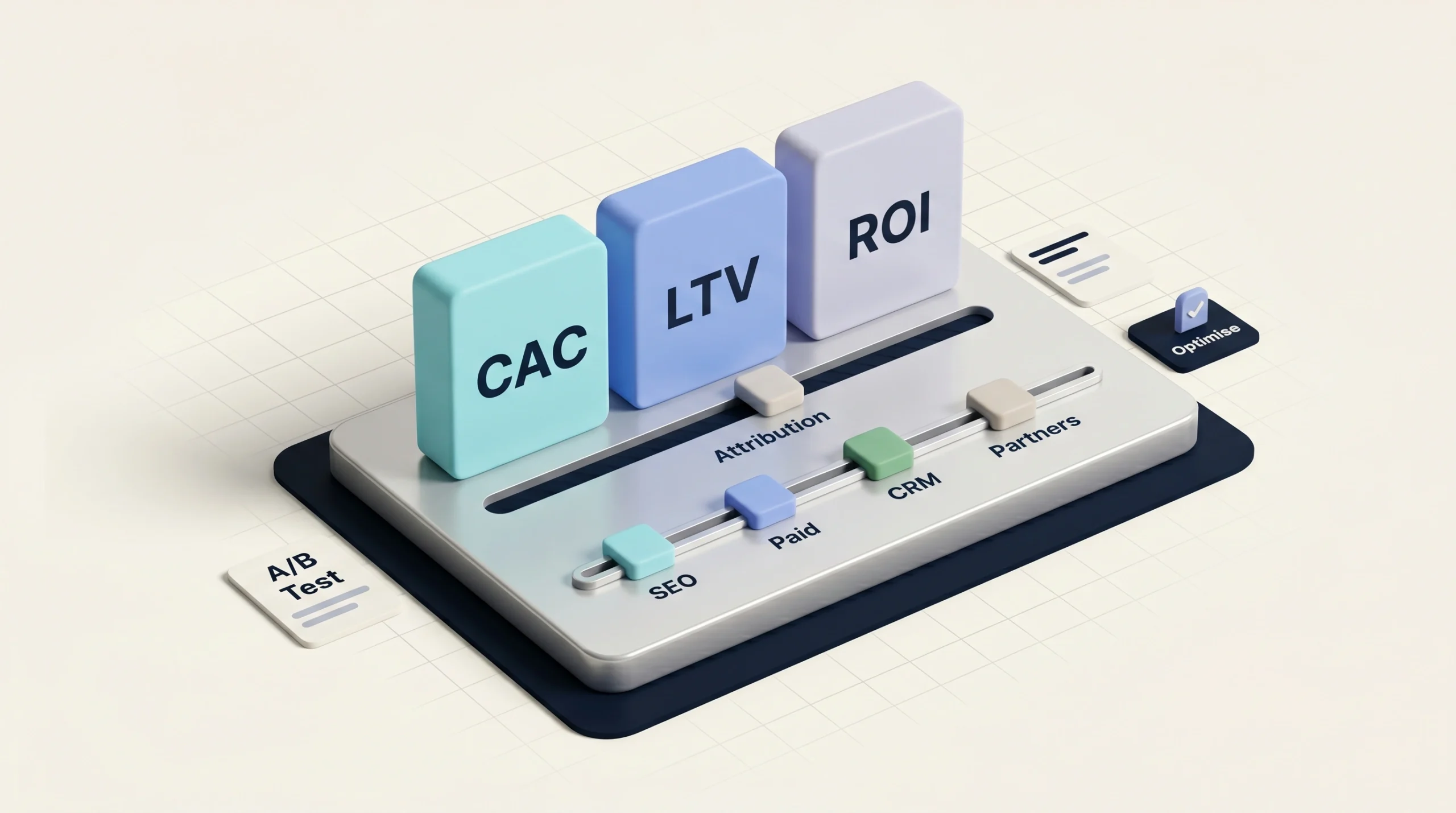
Analytics should connect marketing activity to business outcomes without pretending that every interaction can be attributed perfectly. Reliable decisions often combine platform data, CRM records, finance information, and qualitative evidence.
CAC, LTV, and ROI
Customer acquisition cost, lifetime value, and return on investment are useful only when definitions remain consistent. A CAC calculation should include the relevant media, agency, technology, creative, partner, and operational costs rather than media spend alone.
LTV assumptions should be reviewed by cohort, region, product, and channel. A short period of high trading volume does not necessarily indicate durable value. Likewise, average spread revenue may vary significantly between customer groups and market conditions.
Attribution Across Channels
Attribution attempts to estimate how channels contribute to conversion. No single model captures the full journey, especially when users switch devices, reject tracking, interact offline, or return through branded search.
Compare several views:
- First-touch acquisition
- Last-touch conversion
- Multi-touch contribution
- Incrementality tests
- CRM source data
- Regional or campaign holdouts
- Qualitative sales and support feedback
Attribution should guide decisions, not create false precision.
Budget Allocation
Budgets should reflect commercial priority, channel capacity, evidence quality, and risk. Teams should allocate funds incrementally rather than commit the full annual budget before validating performance.
| Budget area | Primary purpose | Useful evidence | Common risk |
| SEO and content | Long-term visibility and authority | Qualified organic traffic, assisted conversions, and topic coverage | Slow feedback or unfocused publishing |
| Paid search | Capture active demand | Eligible leads, activation, marginal CAC | High competition and policy restrictions |
| Paid social | Awareness, retargeting, audience development | Incremental reach, qualified engagement, assisted conversion | Weak intent or targeting limits |
| Affiliates and IBs | Partner-led distribution | Verified clients, retention, compliant source data | Fraud, misrepresentation, attribution disputes |
| Email and CRM | Activation, retention, reactivation | Lifecycle progression, engagement, and reduced inactivity | Poor data, consent issues, message fatigue |
| Events and PR | Authority, relationships, market access | Relevant meetings, coverage quality, pipeline influence | High cost and weak attribution |
Budget reviews should include marginal performance. A channel may remain profitable overall while the next unit of spend performs poorly.
Testing and Optimisation
Testing should begin with a defined hypothesis. Changing multiple elements at once makes results difficult to interpret.
A useful process is:
- Identify a measurable problem.
- Review available evidence.
- Define one primary hypothesis.
- Select a meaningful success metric.
- Set sample and timing requirements.
- Run the test without unnecessary changes.
- Document the result and next action.
Tests may cover messaging, forms, landing pages, audience criteria, email timing, or onboarding guidance. Compliance approval should be included when changes affect claims or financial promotions.
Adapting to Market and Regulatory Changes
The operating environment can change quickly. Advertising policies, local regulations, product restrictions, search behaviour, competition, and market sentiment may all affect channel performance.
Teams should maintain:
- Regulatory monitoring
- Platform-policy alerts
- Approved-message libraries
- Market-level dashboards
- Content update schedules
- Partner communication processes
- Scenario budgets
- Incident response plans
Adaptation should be controlled. A sudden drop in paid traffic does not automatically justify shifting the entire budget to affiliates or organic publishing without assessing quality, capacity, and risk.
Common Forex Broker Marketing Mistakes
Many performance problems come from strategic misalignment rather than a lack of activity. The following mistakes often increase cost, weaken trust, or make results harder to evaluate.
Trying to Target Every Market at Once
Expanding across many regions can fragment budgets, localisation, support, compliance, and measurement. A narrow initial focus often produces clearer evidence.
Prioritise markets using:
- Regulatory access
- Product fit
- Search demand
- Competitive intensity
- Payment and onboarding capability
- Support capacity
- Expected customer value
Expansion should follow validated operations, not only available traffic.
Prioritising Lead Volume Over Lead Quality
High lead volume can conceal poor eligibility, weak intent, fraud, or low activation. Teams should report downstream outcomes alongside cost per lead.
A better scorecard includes:
- Verification rate
- Eligible account rate
- Activation
- Retention
- Support burden
- Fraud
- Net contribution
This shifts attention from cheap forms to commercially relevant demand.
Using Generic or Non-Compliant Messaging
Claims such as “best platform,” “lowest spread,” or “superior trading experience” require context and evidence. Generic superlatives also make brands sound interchangeable.
Messaging should explain specific strengths, limitations, audience fit, and proof. It should never imply guaranteed profits, safe forex trading, or certain outcomes.
Failing to Connect Marketing With CRM Data
Without CRM integration, teams cannot see what happens after a lead is generated. Media platforms may report conversions that do not translate into verified, eligible, or active relationships.
Connect campaign, website, CRM, and product data through agreed identifiers and governance. Reporting should remain privacy-conscious and limited to information needed for legitimate measurement.
Depending Too Heavily on One Acquisition Channel
A single-channel model creates exposure to policy changes, ranking volatility, partner disputes, or rising media prices. Diversification reduces dependency but should not become uncontrolled channel expansion.
A balanced portfolio may combine:
- Organic search
- Educational and product content
- Paid search
- CRM
- IBs and affiliates
- PR and events
- Social media
- Direct partnerships
Each channel should have a clear role, owner, metric, and risk limit.
Forex Broker Marketing FAQ
The strongest mix depends on regulation, market, audience, website quality, product fit, and budget. SEO, educational content, paid search, CRM, affiliates, IBs, PR, and events can all support growth in specific scenarios. A brokerage should prioritise channels that produce qualified demand, can be measured beyond registrations, and align with its compliance and operational capacity.
Qualified leads usually come from precise positioning, intent-matched content, controlled targeting, relevant landing pages, and clear eligibility information. Teams should define lead quality before launching campaigns and connect marketing data with verification, activation, and retention outcomes. This makes it easier to reduce irrelevant traffic and invest in channels that attract audiences suited to the product.
There is no universally lowest-cost channel. Organic search may become cost-effective over time, while paid search can capture immediate intent but face higher competition. Affiliates may offer variable-cost distribution but require strong oversight. The more useful comparison considers total acquisition cost, verification, activation, retention, fraud, compliance workload, and the marginal cost of additional volume.
Regulations can affect eligible audiences, claims, risk warnings, incentives, product presentation, influencer activity, and approval processes. Advertising platform rules may add verification or targeting requirements, but do not replace legal obligations. Each campaign should be reviewed against the relevant jurisdiction, regulatory entity, product type, communication channel, and audience before publication or distribution.
Retention may improve when the product, onboarding, support, CRM, and communication work together. Brokers should examine inactivity reasons, platform friction, service issues, customer relevance, and message frequency rather than rely only on bonuses. Lifecycle email marketing, useful product education, responsive support, and appropriate reactivation campaigns can help build long-term relationships when implemented responsibly.